If you played Zorkback in the day (or discovered it later like most of us), you know the drill. "You are standing in an open field west of a white house." No picture. No soundtrack. Just words and your imagination doing all the heavy lifting.
For almost 50 years, that's been the deal with interactive fiction. The stories got smarter, especially once AI text generators like AI Dungeon showed up in 2019, but they still looked the same: text on a screen, maybe a static image or two if the developer had an art budget.
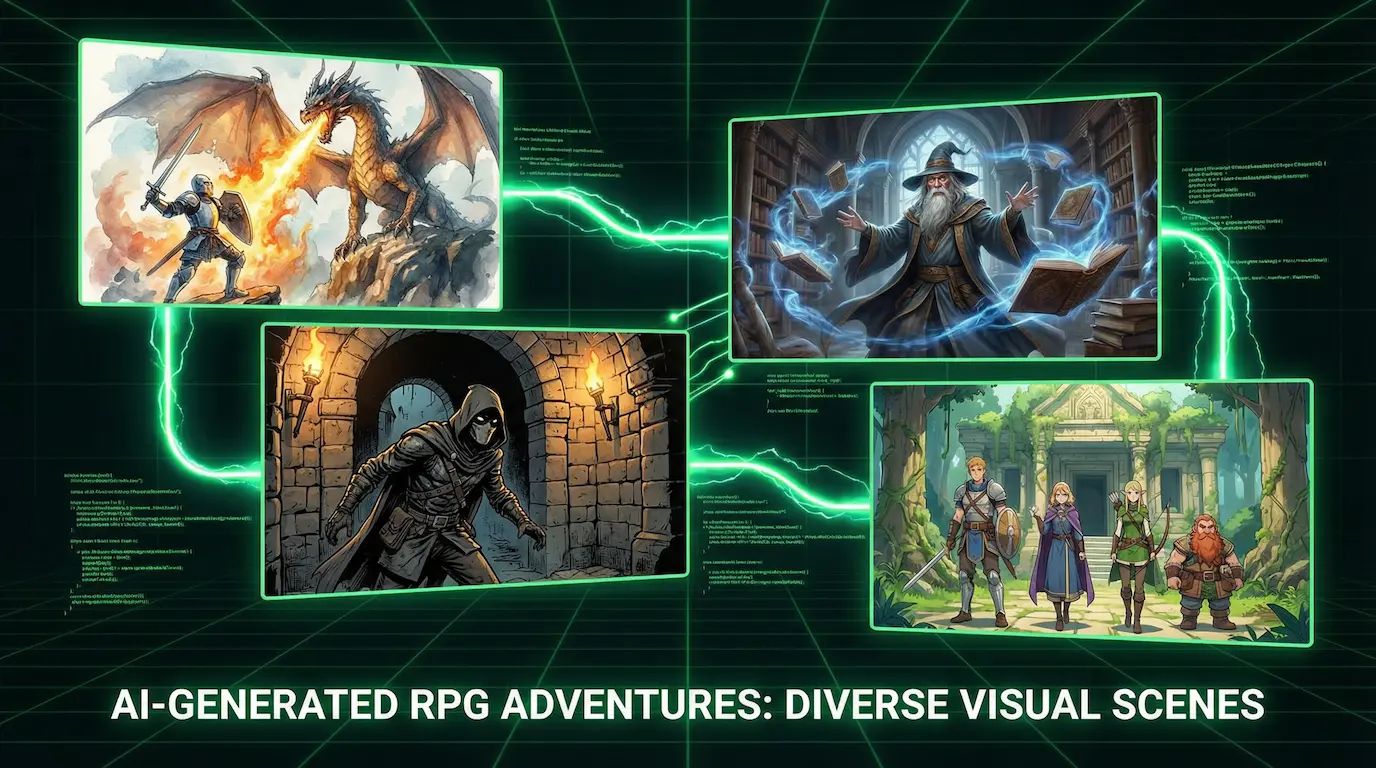
That's changing fast. AI image generation has gotten good enough, and fast enough, that games can now illustrate every single scene on the fly. Not generic stock art. Actual illustrations that match what's happening in your story, with yourcharacter in them, in whatever art style fits the mood. And it's turning interactive fiction into something that feels completely different from what came before.
How We Got Here

Quick history lesson. Infocom made Zork and Planetfall in the late 70s and 80s, and they were pure text. The 90s brought point-and-click adventures (think Monkey Island), the 2000s gave us visual novels, and then in 2019, AI Dungeon proved that a language model could generate infinite story paths in real time.
But even AI Dungeon was still just text. The AI could write about a dragon attacking a castle, but you had to picture it yourself. There was no visual layer.
Then image generation models like DALL-E, Midjourney, Stable Diffusion, and FLUX caught up. Suddenly you could turn a text description into a detailed illustration in seconds. The question stopped being "can we make images from text?" and became "can we wire this into a game engine tightly enough that the art actually feels like part of the story?"
Turns out, yes. And the results are kind of wild.
Why This Is a Bigger Deal Than It Sounds
Sticking pictures into a story isn't new. Choose-your-own-adventure books had illustrations decades ago. The difference is that AI art is procedural. It's generated fresh for every scene, every playthrough, every decision. Here's what that actually changes in practice:
No Two Playthroughs Look the Same
In a traditional game, an artist draws a set number of scenes and they get reused. With AI generation, if you pick the cave instead of the bridge, you don't get a generic "cave.jpg" pulled from a folder. You get this cave, at this moment in the story, with your character standing at the entrance holding whatever they picked up three scenes ago. Play it again, make different choices, and every illustration is different.
The Art Actually Responds to Your Choices
This is the part that surprised me. When you choose to negotiate with the bandits instead of fighting them, the generated scene doesn't just swap in a "talking" template. You see tense body language, lowered weapons, a campfire between the two groups. The art reinforces the emotional weight of your decision. It makes consequences feel visible, not just described.
You Don't Need an Art Budget Anymore
This one matters more than people realize. Before AI art, making a visually rich interactive story meant hiring artists and commissioning hundreds of scene illustrations. Only well-funded studios could pull it off. Now a solo creator can build a fantasy epic, a noir detective story, or a kids' adventure, and every scene gets its own unique artwork. The playing field got leveled overnight.
Seeing It Hits Different Than Reading It
There's a reason movies hit harder than books for most people (sorry, book lovers). Visuals create immediate emotional impact. When you seethe city burning because you made the wrong call, or the sunrise over a kingdom you just saved, that lands differently than a paragraph describing it. AI art closes the gap between "interactive book" and "playable movie."
The Hard Part: Making Characters Look Consistent

Anyone who's messed around with Midjourney or DALL-E knows the biggest problem: ask the AI to draw the same character twice and you'll get two completely different people. Different face, different hair, different build. For a one-off image that's fine, but for a story game where you're supposed to be the hero across dozens of scenes? It breaks everything.
Fixing this isn't just about writing better prompts. It takes a whole pipeline: character reference images, style embeddings, pose guidance, composition logic. The kind of stuff that's really hard to hack together on your own.
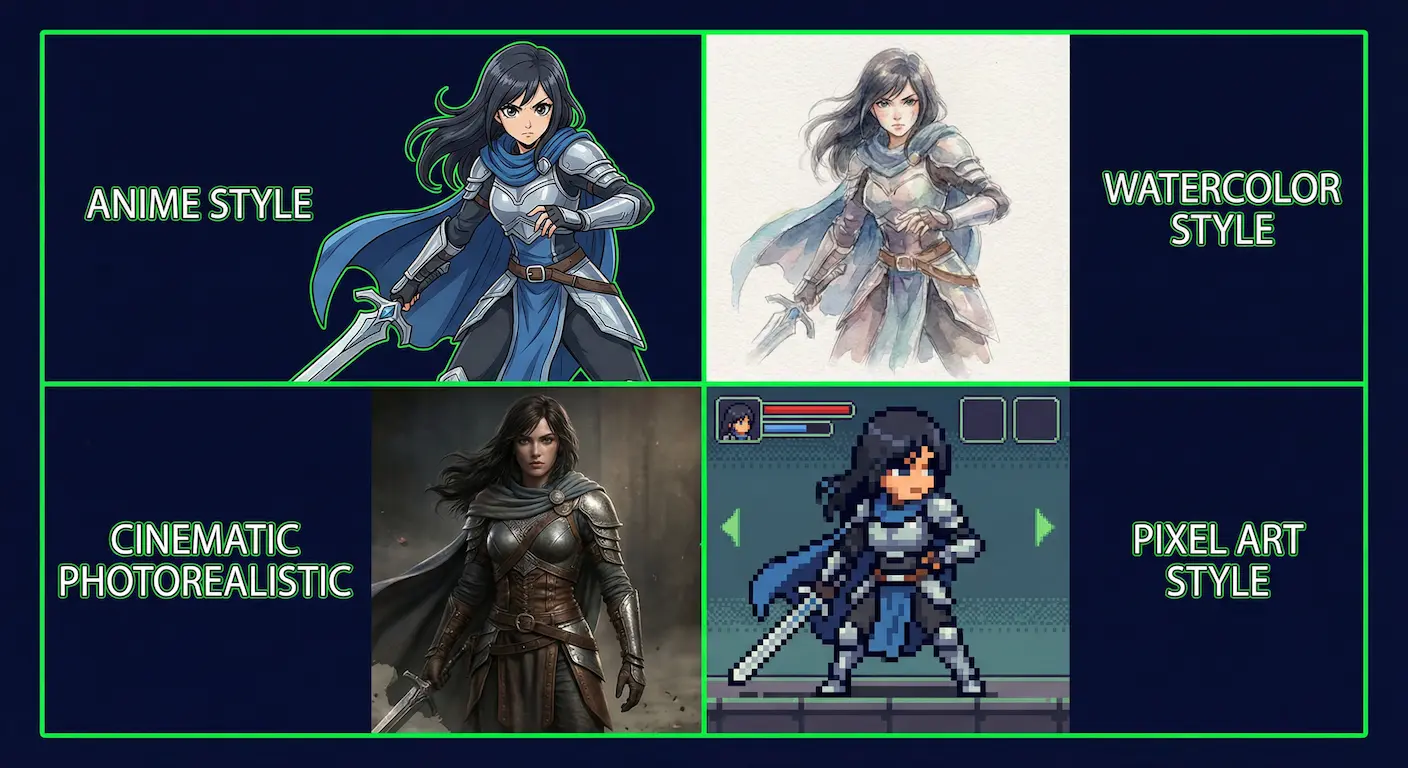
This is actually where purpose-built platforms separate themselves from the "just use ChatGPT" approach. On aiga_, for instance, you can upload a photo of yourself and the AI renders you as the main character in every scene. Your face, your outfit, your proportions stay consistent whether the story is in anime style, watercolor, cinematic realism, or anything else. Scene one and scene fifty look like the same person. That might sound like a small thing, but it's the difference between a gimmick and something that actually feels immersive.
Using Art Style as a Storytelling Tool
Here's something I didn't expect to care about but ended up finding really cool. In traditional games, the visual style is locked in at development time. A game is either pixel art or photorealistic. You pick one and that's it. With AI generation, the style can actually changeto match what's happening in the story.
Think about a horror story that starts in warm, friendly watercolors and gradually shifts to dark, scratchy charcoal as things get tense. Or a time-travel adventure where the medieval sections look like tapestries, the 1920s scenes are Art Deco, and the future is neon cyberpunk. The art style itself becomes part of the narrative. You feel the mood shift before you even read the text.
aiga_ already lets creators pick from a library of art styles for their worlds. A kids' story can use bright animated illustrations. A dark fantasy uses cinematic lighting. A comedy leans into exaggerated cartoons. It's a creative choice now, not a production constraint.
Multiplayer Makes It Even Better

Playing solo is great, but the magic really clicks with a group. A bunch of people vote on a story decision, the AI processes the winning choice, and then everyone sees a brand-new illustration of what just happened. Nobody's seen that image before. It was created from the group's collective decision. There's something genuinely exciting about that.
With aiga_'s connections for Discord, Telegram, and X, this happens right inside the platforms people already use. A Discord community votes on whether to storm the castle or sneak through the sewers, and the result shows up as an illustrated scene posted straight to the channel. It turns a chat server into something way more interesting.
For content creators and brands, there's a nice side effect: every session generates a stream of unique, illustrated content. Each image is shareable, each one was driven by audience participation. It's organic content that makes itself.
What This Opens Up for Different People
The cool thing about AI-illustrated interactive fiction is how many different use cases it unlocks. Not just "gamers," but people you wouldn't normally associate with text adventures:
- World builders and game designers can prototype visually rich game worlds in hours instead of months. Focus on the story and the branching logic, let the AI handle the art, then share your world with the community so others can play it.
- Tabletop RPG game masters get to run campaigns where every encounter has its own illustration. Your players actually see the dragon, the NPC, the dungeon. No more "okay, imagine a big room with pillars."
- Teacherscan build interactive lessons where history and science come alive visually. Students don't just read about ancient Rome. They see it, rendered in historically inspired art, with their decisions shaping what happens next.
- Brands and marketing teams can create interactive campaigns where audiences vote on the plot. Every scene generates visual content that's built to be shared.
- Writersget to see their stories illustrated as they build them. It's like having a concept artist on call 24/7.
How It Works Under the Hood
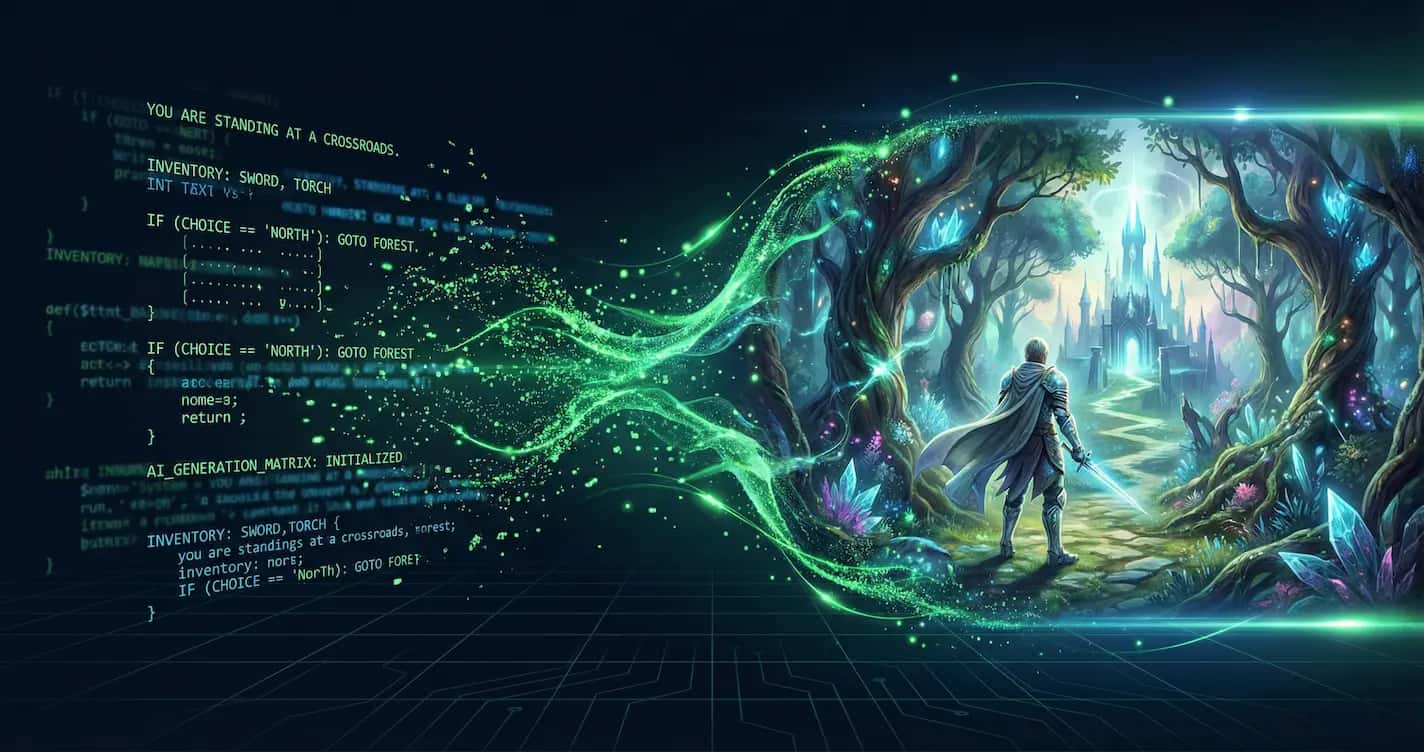
Making one good image from a prompt is easy. Making hundreds of coherent images across a branching story that all look like they belong together? That's the engineering challenge. Here's a simplified version of how it works:
- The AI reads the story event and pulls out the key visual elements: where it takes place, who's in the scene, the mood, time of day, and any important objects or actions.
- Those elements get combined with the world's art style settings and any character reference data to build a detailed image prompt.
- If the player has a custom hero (like a photo upload), the system injects reference embeddings so the character appears consistently.
- The prompt goes to an image model (FLUX, DALL-E, Stable Diffusion, etc.) which renders the scene. Some pipelines run multiple passes for refinement.
- The generated image gets checked for quality, safety, and consistency with previous scenes.
- The finished illustration gets paired with its story text and delivered to the player, whether that's on the web, in a Discord embed, a Telegram message, or an X post.
The whole thing takes seconds. By the time you finish reading the story text, the illustration is already there.
Where This Is Heading
We're still early. Like, really early. Here's what's coming:
- Animated scenes instead of static images. Think short cinematic clips generated in real time from the story context. A battle plays out as a 5-second animation instead of a still frame.
- AI voice actinglayered on top of the visuals. Every story game becomes a personalized animated series where you're the main character.
- Persistent world states. If you burned down the village in chapter two, every scene set in that location for the rest of the game shows the ruins. The world remembers what you did, visually.
- Custom art styles where you upload reference art and the entire game adapts to match your aesthetic. Same story, totally different look for every player.
- Export to other formats. Imagine finishing a game and exporting the whole thing as an illustrated e-book, a comic strip, or an animated short. Your playthrough becomes a publishable piece of art.
Bigger Than Gaming
What excites me most about this isn't the gaming angle. It's that AI-illustrated interactive fiction is becoming a genuinely new creative medium. It sits somewhere between games, literature, visual art, and community participation. And it's accessible to basically anyone.
A teacher can build an illustrated history adventure for their class without knowing how to draw or code. A group of friends can play through a custom RPG and walk away with a gallery of unique artwork from their session. A brand can launch an interactive visual campaign without hiring an animation studio.
That's the real shift. Stories you don't just read or play, but stories you see, shaped by your choices and rendered uniquely every time.
Try It Yourself
If any of this sounds interesting, aiga_ is where we've been building exactly this. Every scene gets illustrated, your character stays consistent the whole way through, and you can play solo, with friends, or with entire communities on web, Discord, Telegram, and X.
Build a world, play someone else's, or just jump into a game and see what AI-illustrated storytelling actually feels like. It's free to get started.